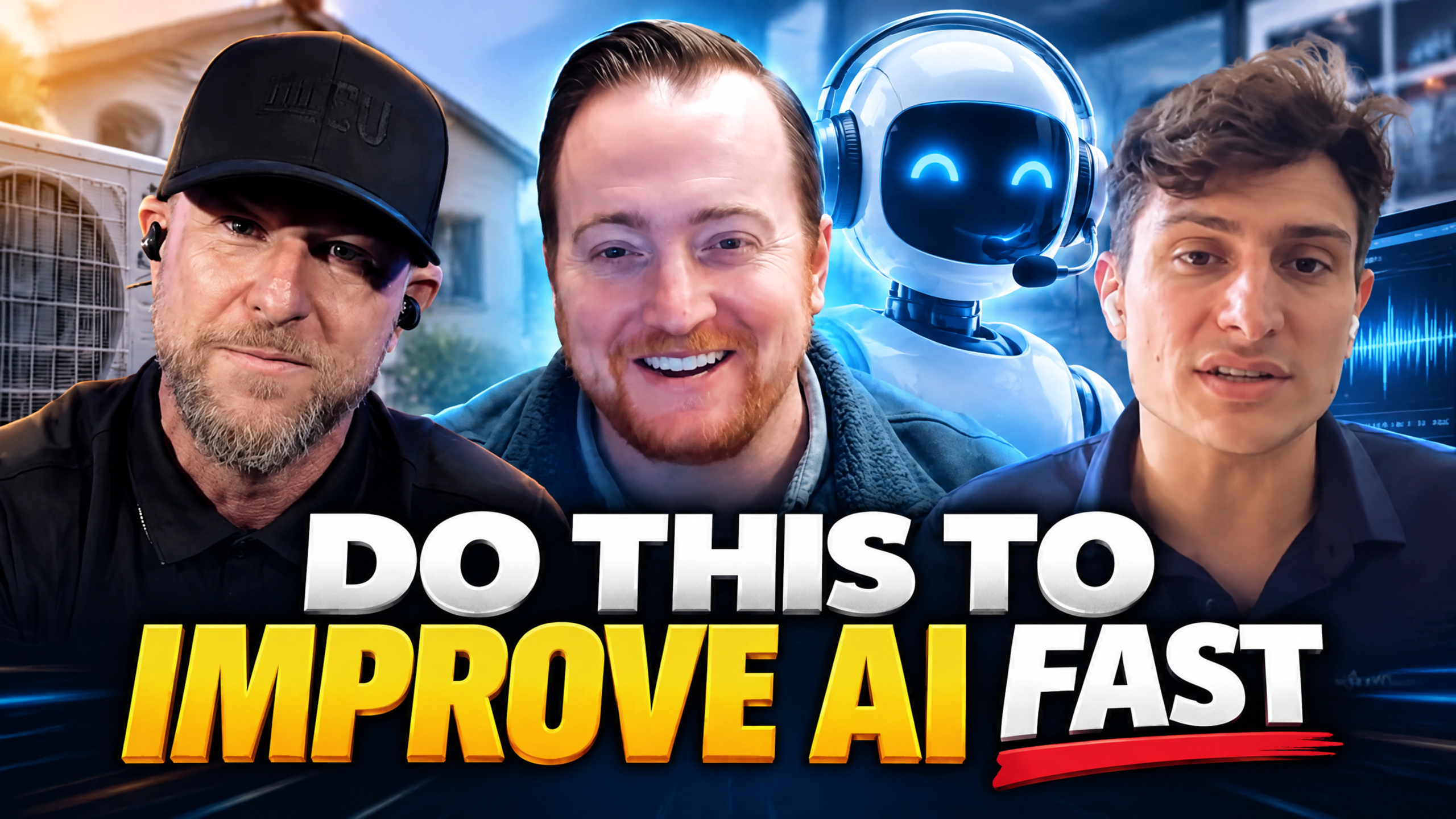
Train AI to Work Like Your Best HVAC CSR
Are you treating AI like a new employee or expecting it to perform perfectly from day one? When AI is responsible for answering calls and booking jobs, getting it right takes more than flipping a switch there needs to be an onboarding and ongoing training.
In this episode of Cracking The Code, Federico Collarte of Avoca explores how correcting AI mistakes helps improve performance and why the biggest opportunity goes beyond saving time to capturing more leads and booking more jobs. They also discuss how AI is transforming call centers and what contractors need to do to make the technology work for their business.
Podcast: Play in new window | Download
00:00:00:01 – 00:00:10:19
At this point, we have several customers where the AI is performing better across all metrics than their average CSR.
00:00:10:21 – 00:00:35:10
Do you know that you can actually get rewarded for telling us about your industry experiences, e.g., I. A’s annual Contractors survey for HVAC Business leaders is open. And by participating in the survey, you can help build the benchmarks that show how contractors are running and growing their businesses. Giving contractors a clear look at how contracting businesses are approaching growth challenges and new opportunities.
00:00:35:12 – 00:01:04:10
And there’s something in it for you. Actually three things. Once you complete the survey, you get instant access to our 93 page survey report. Receive a free copy for the upcoming report with all new findings and pure insights. Plus, you’ll get entered to win a VIP epic 2027 package that includes a free conference registration, two nights stay at Mandalay Bay, and access to celebrity meet and greets like with Jim Gaffigan, Mike Cicero, Ray Lewis and more.
00:01:04:12 – 00:01:10:02
Take the survey today at ega.org/survey.
00:01:10:04 – 00:01:33:15
Welcome to another episode of Cracking the Code with your host, Jada Moneymaker, and my co-host, Brad Bear. And I’m super excited about this episode because we’re going to dive in deep about technology. Where’s technology going? Within the trades, this is what everyone’s hyper focused on. And I’m telling you, if you’re not jumping on it, you’re going to be left behind.
00:01:33:19 – 00:02:00:06
I’m super excited because our guest is Federico and he is also the owner of Voca, which is also a proud partnership of e.g. I a and this is changing the industry all across the nation, dialing in how to better improve your system so you run more efficient so you get a better outcome. Federico man, welcome to the podcast Cracking the Code.
00:02:00:09 – 00:02:22:17
Absolutely. Thanks for having me. Super excited to be here. All right. Well, first off, tell me a little bit about Avoca. Yeah. Happy to. Well, Avoca is obviously an AI company in the trades. We started out kind of trying to solve the hair on fire problem. That seems like, home services businesses have, which is really the call center.
00:02:22:18 – 00:02:44:17
It’s the phone. It feels like they’re really running the. A lot of them are running the field and the technicians operations like a machine. But then a lot of the a lot of the call center stuff is left, is kind of like there’s improvements that can be done there. And we all know that not answering a call is basically like setting money on fire.
00:02:44:17 – 00:03:08:09
So that’s the first problem that we tackled with a with a bow. So without we also have human beings answering the phone 247. And then from there on our customers started saying, hey, this is this is working really great. But I’m also getting leads from Google, from ads from Angie and a bunch of other sources. So then we started patching those leaks, and once we did that, they were like, oh, can you help me fill the board?
00:03:08:12 – 00:03:31:23
So then we have outbound campaigns and so on and so forth. So at a very high level, if you if you were to simplify a business in three steps, you got to capture leads, convert leads into jobs and then actually perform the jobs. And the Voca is a bogus goal is to take care of the first two so that contractors can really focus on what they do best, which is actually going and performing the jobs.
00:03:32:01 – 00:04:04:15
Now, quick question for you. When you’re out banning campaigns and leads and you’re generating it through AI. Now I know all markets are different. All companies are different. But hyper focusing on that. How many leads or opportunities are we getting on an average sized company? Oh, that’s such a I mean, that’s a very general question already. When you talk about outbound, that’s that’s one word that can mean a bunch of different things, like an album campaign could be something as simple as a happy call.
00:04:04:16 – 00:04:40:09
Right. Or where you’re not really generating leads. Or it could be a promo. It could be, for example, a membership that is about to expire. So you can do a campaign with those people. It could be a maintenance setup, right? It could be a lot of different things. So that would vary. The thing that is really cool in my opinion, about leveraging AI to do this type of stuff is one, well, one, what it was just saying is that you can dynamically create audiences so that you don’t have to kind of spray and pray, right, as opposed to say like, hey, I’m going to grab a thousand people from my CRM and message
00:04:40:09 – 00:05:04:22
them. You can really start dividing them into 50 different audiences even more. Right? Like very my new they have all of these different things in common and then send a very specific campaign with a very specific type of verbiage for those specific people. And also if they respond, right, it’s not an automation, there’s no templates, there’s no auto replies, there’s nothing preset.
00:05:05:00 – 00:05:26:03
You’re really trusting a machine, kind of like you trust GPT to always give you a right answer that that is cohesive. You’re really trusting your your agent to understand the context of whatever the customer or the lead is saying, and then come up with a with an answer that moves them towards the goal, which usually is to get them booked into the CRM.
00:05:26:04 – 00:05:58:01
Right? So that’s that’s the I think the cool thing. And then the other one is being able to do it in a way that is very intelligent, almost like surgical, where you can really use a lot of data points, whether it’s like weather predictions. Last year’s historical performance or even like average conversion rates based on campaign type to really determine when to go more or less than like a knob right of of of the volume.
00:05:58:02 – 00:06:19:06
So once again, it’s not just a thousand. It’s like, hey, I’m going to send 200 in real time, see how many are responding to me, adjusted predictive algorithm, and then continue messaging them out in a way that you never really go overboard. But also, you are you’re filling the board. So I hope that provides a little bit of clarity around what the goal around this campaign is.
00:06:19:08 – 00:06:42:10
AI is probably, I would say, going back to what Jason said originally, one of the most talked about things in home services right now. I mean, there was pantheon was just, you know, add we have tons of breakouts of of what’s going on with AI from your seat, Federico. From your seat. What do you think the biggest gains have been in AI over the last?
00:06:42:11 – 00:06:57:02
Maybe you know, 1 to 2 years and then what are still some of the gaps that you think are present that hopefully in the next couple of years will be solved. So what are the biggest gains in the last couple of years and are gaps. Sorry. And what do you think the gains are going to be in the years to come?
00:06:57:04 – 00:07:18:09
Gains and gaps. Yeah, it’s a good question. I think that when it comes to the gains, I think it’s particularly interesting because it’s it’s it’s interesting to me how for a lot of our customers, the biggest games, when they when they kind of come in and want to use AI, they’re thinking about it in terms of savings, in terms of costs, in terms of optimization.
00:07:18:11 – 00:07:41:04
But pretty soon they realize that that is actually a kind of like a externality, like a second order derivative benefit of what happens when you use a company like Avoca. But it’s not the biggest game. The biggest gain is on the top line. It’s the roof. It is not saving the inefficiency. That’s the second order. It’s really being able to capture every call, capture every lead.
00:07:41:06 – 00:07:55:08
More jobs. We have a lot of testimonials from customers who say, my biggest problem problem right now is hiring enough technicians. That’s a good problem to have, but it’s hiring you for royalty then.
00:07:55:10 – 00:08:24:06
I need that problem. Yeah, yeah I know, well, hey, maybe we need to talk after this podcast then. But it is. Jason’s always working. He’s always recruiting. I’ll be, I’ll be, I’ll be a live testimonial, man. Yeah, yeah, that’s that’s really the the biggest gain is, is truly understanding that, hey, AI is not perfect first and foremost. Like, I think a vocal is known for being a company that doesn’t try to force AI.
00:08:24:08 – 00:08:47:13
That’s what we sell a lot of stuff that is not even AI, but it does have some advantages. It’s very, very flexible and scalable, right? Humans are it inherently we can only be in one place at a time. But but I can do a million things at once. So that’s the most obvious one. Yeah, it’s also much more intelligent than us.
00:08:47:16 – 00:09:17:18
But then when you talk about, like, the gaps. Right, Brad? Why don’t the gaps, that is certainly going to be, kind of filled in the next, in my opinion, probably six months or so is the is how the voice sounds right now. I think, speaking for a vocal, we are on what we call V3. We are moving all of our customers onto V3, and we’re seeing an average increasing booking rate of 10% immediately in the first week upon moving them on to week three V3.
00:09:17:23 – 00:09:44:16
So, every time that the technology gets better, the whole industry benefits from it. I at this point we have several customers where the AI is performing better across all metrics than their average CSR. Not their worst, not their best, but their average, which is kind of mind blowing to think that V2 just six months ago or whatever was was definitely not there.
00:09:44:18 – 00:10:02:08
The thing, the thing that’s quite crazy is that this thing is moving so fast that in a matter of here, I’m going to be very, very conservative a year which is not that far away. I am very confident that the quality of the voice, which, by the way, most people stop it how it sounds. But it’s not just about that.
00:10:02:09 – 00:10:26:13
It’s also about the verb. The verbiage uses, the emotion, the breathing. There’s a lot of new ones that goes into it will be so good that it will be 80% of all, of all CSRs. And we are getting pretty close to the point where people will basically say, hey, like you’re you’re not quite cutting it. Can I speak to your AI?
00:10:26:15 – 00:11:00:20
I’ve ever I’ve heard this one before. But, from from a prospect. But it is true, though it truly is is the case. And I mean, it’s not that hard to wrap your head around that when a you are seeing in the last two years just the pace and b you have a lifetime of experience, whatever that means for you of calling in to call centers, whether there is your doctor, your hotel, your airline or your H, you know, service provider and receiving somewhat not great service.
00:11:00:21 – 00:11:32:12
I’m sure you’ve experienced it before. And so I think that that’s an area where I can, can, can really, really improve the customer experience and the. Yeah, the life of kind of like the average person. How do you see AI, being integrated in to the call center? And by that I mean, what what do you think best practices are for contractors looking to integrate technology AI with live humans?
00:11:32:12 – 00:11:56:04
Right. With CSRs and dispatchers, what’s your vision on how that can and should work in the most effective capacity? Yes, that opens up a huge topic, which is change management. I think that like opening up huge topics. It’s great. That’s I’m good at it, which is let’s let’s dive in the engine purely. Let’s keep going. Yeah, I think that’s great though.
00:11:56:05 – 00:12:17:18
Let’s dive into change management I like it. Yeah. I mean, we have to realize that when we talk about AI, there’s a million things that that that can happen. Right? But when we talk specifically about implementing an AI agent, that is the gate between your leads and your revenue, that’s a big task, right? This is not a little AI tool to help you become save an hour a day.
00:12:17:19 – 00:12:42:20
This is literally like revenue generating a revenue generating machine. The implementation needs to be taken seriously. This is like if you were hiring a person whose entire responsibility is to, you know, book revenue, you’re not just going to hire them, give them a script and say, good luck. You’re going to stay behind it. You’re going to track it every single day for multiple months, correct?
00:12:42:20 – 00:13:06:11
Every single mistake they they make hope they don’t make them again. If they make them again, then you’re going to tell them again, right? That’s how you treat a human that has such an important task. Many times, because we have been accustomed with using automations that are kind of like setting and forget it. People come into the world of AI thinking of AI the same way as automation, because after all, it’s a computer.
00:13:06:11 – 00:13:27:05
It’s not a human. And so they kind of just like go through the steps of setting it up, connecting it to service Titan or whatever other CRM they use, and then once it goes live, they expect it to perform and it doesn’t. And it’s not meant to. And if it did, it probably would be some, you know, simpler automation that is not very flexible.
00:13:27:07 – 00:13:45:12
So I think that that’s the number one thing is, is like really coming in with the mindset that you’re hiring. I like to say you’re hiring Einstein off the street. Einstein is a genius. He could probably have figured out any job. But if you just kind of like, say, good luck, they’re not going to be good on the road if you spend time training them.
00:13:45:12 – 00:14:04:22
Here’s the thing once once the AI makes a mistake, it’s you. Correct it. It’s never going to make it again because it doesn’t have 20 years of experience making that mistake. Right? You just you just fix it. So that I think is the biggest thing. The second thing is also going in with the patients that is required for this.
00:14:04:23 – 00:14:29:08
And I’ll call something out when Tesla runs into an accident with the automatic driver. Right. That’s international news. There is a bias against robots making mistakes. That is like a huge deal. But humans make mistakes on the wheel every single day. And it’s very unfortunate, right? Like people lose their lives every single day. That’s not even news because humans can make mistakes.
00:14:29:13 – 00:14:50:05
And so there is a huge double standard that sometimes is applied to when an AI makes a mistake, maybe on their on its first month before it’s even fully, fully trained. And the reason why I say this is not because, you know, obviously we don’t like when that happens, but that’s not the reason. It’s because I want the customer, I want the AI is it’s inevitable.
00:14:50:06 – 00:15:13:11
Like whether you go with a competitor you do on your own, like you have to do it. You just there’s no way around it. And the thing is that if you get discouraged on the first mistake because you have this double standard, you’re really just hurting yourself. And so that’s something that’s very important in my mind to take in to you, to keep in mind is that you need to really stay behind it for at least three months, like you would with a human.
00:15:13:15 – 00:15:26:04
And you also have to have the same standards as you would with a human. You can give up and say this work. Sorry, I don’t know if I’m allowed to say that, but you’re good this work when you say it. Yeah, well.
00:15:26:06 – 00:15:47:19
Just because you know and give up too early. So those are my two big call outs. Well, let me ask you a question. Who should be using AI right now? Okay. First, for most every single person in the United States of America is using AI today. If you use Gmail, you’re using AI because Gmail has a spam filter and it’s headed for 15 years.
00:15:47:20 – 00:16:11:18
If you use Google Maps, you’re using AI because it’s it’s using predictive analytics and machine learning, which is what AI is, after all, to determine the best route and calculate how many minutes will take you to walk there or drive there. So first and foremost, everyone is using AI. Now, when we’re talking about generative AI that’s coming up with new is basically creating new content in real time based on context that you give it.
00:16:11:20 – 00:16:36:23
The question is who should be using it? It might be, anyone who is trying to better themselves, grow and stay relevant. I was not really an adult when the.com thing happened, but I understand that it was quite a big deal. Lots of companies ended up, you know, going under and failing. But look at look at where we are now.
00:16:37:01 – 00:16:56:20
I’m sure that there were people back there who are like, oh, like, I don’t need a website. Like, everyone knows me. You know, everyone around here knows me like it’s it’s it’s my business is all word of mouth. I don’t need to run Google ads eventually became and look at it now. Google ads are so expensive because simple supply and demand.
00:16:57:00 – 00:17:22:11
Everyone’s relying on it. It’s it’s it’s necessary. You cannot live without it. And so AI is is no different. In fact, it’s probably even more powerful because like I said, generative AI for the first time since like 3 or 4 years ago, we have this new thing that is generating new new things, new content, new images, new campaigns, and it’s running automatically entirely.
00:17:22:12 – 00:17:45:07
So it’s it’s when you ask who should do it. I mean, it’s, it’s kind of the same as who should be adopting the internet. What are you going to do if you don’t have the internet? You’re going to be left in the dust. Federico, let me ask you a question. Where did you get your passion behind? Like where do you find the passion to help people in the trades with the software?
00:17:45:07 – 00:18:07:02
And because when I talk to you. Right, like I could feel and I could see the passion behind it of wanting to help companies run more efficient. Well, he, you know, he was a competitive skier in the Italian Alps. Am I right on that? So there’s some there’s some passion and competitive nature there. Yeah. I, I grew up in a in near Milan in the Italian northern region.
00:18:07:02 – 00:18:33:18
And yeah, it was a competitive skier and soccer player. My whole youth. But yeah, there’s definitely some passion that comes from from that and just from being Italian, I guess. But besides that, being a dad, I think that. Yeah. Yeah, we’re very, very passionate bunch, I hear. But, well, first, my dad owns a small home improvement, you could call it business.
00:18:33:20 – 00:19:01:05
And so, and my great, great by originally started it. So it kind of like runs in the family. This is in Italy. But besides that, I think that when I came to the United States, I was 17 years old, and I came here for just a year. But at the end of the year, I decided that I was going to stay, and I was going to kind of pursue my dreams, my ambitions, and this country really gave me an opportunity.
00:19:01:07 – 00:19:25:03
I’ve seen my parents working hard their entire lives, and I am a really hard worker myself. And when I got exposed to the trades, I, I really saw people who kind of share a very similar dream. They want to, you know, they want to do something good, they want to grow their thing, and they work extremely hard. And I really stand behind their mission and their goal.
00:19:25:03 – 00:19:51:23
So, that’s what kind of drives my passion around what I do today. And when I found Avoca, and, yeah, like with what Avoca does, I remember very specifically the very, very early days. I was sitting across the dinner table at a conference from a contractor and a fairly, you could say, fairly large contractor who had so much passion in what he was saying.
00:19:52:02 – 00:20:14:01
And he was saying every single day I missed hundreds of calls. And, that pisses me off. And not because it’s money that is lost and that is left on the table. Of course, that bothers me, but it’s because it’s freezing families that I cannot help. Context. This was February in North Dakota. And so that was that was a few years ago.
00:20:14:02 – 00:20:33:04
That was so inspiring to me to see this man who has, you know, he’s you could say he’s like very wealthy, like he’s not doing it for the money. Obviously, he has revenue goals and employees to pay and all that, but he was so passionate about what he was doing. And I’m sitting across the table and I’m like, this was before we had outbound.
00:20:33:04 – 00:20:55:23
We had direct mail. We had all that stuff. We just like had AI to answer calls. And it was like, ding, right? Like, wait a second. You know, we can take the skulls 247 with receptor hours we can solve the problem. And a few years ago I was in the good and, you know, like it wasn’t perfect. But that’s why we have a whole call center of human beings that can step in when the AI doesn’t work.
00:20:56:01 – 00:21:16:10
And, and, but still, even if you didn’t have anything but a, an AI tool, that’s still better than leaving those people hanging, at least you can provide them some sort of help, at least a portion of them you can help. And so that’s where a lot of the passion for what I do today comes from is, is really that conversation.
00:21:16:12 – 00:21:39:04
Was extremely impactful. And I remember as if it was last night, those types of things can make a big impact for sure. I’ve got a number of stories to. But, when you’re looking to the future with a, what are some things that are coming down the pipe if you’re able to share them, things that you’re excited about being able to deliver to your clients and both current clients and potentially prospective clients listening on the call.
00:21:39:06 – 00:22:10:10
Yeah, absolutely. So as as everyone knows here, we started out with again in bound leads, calls and beyond. Then we did the outbound thing right. So like I said, maintenance campaigns and all that. What coming down the pipeline now is there is a kind of, many people are like, wait, what is direct mail? And, the way the direct mail works for For Avoca is within your album campaign when you can do automated AI texts and calls, we prefer text.
00:22:10:10 – 00:22:33:03
They work usually work better. When it comes to outbound. You can now create a direct mail piece directly within Avoca. And it’s obviously we already have your fonts, your logos, your colors, your brand policies and all that. And in a matter of like 30 minutes, you’re now creating a direct mail flier with a QR code within the platform.
00:22:33:05 – 00:23:08:15
And you can either talk with AI to make edits, or you can do it like it was PowerPoint and just make your own edits. And then you press a button and this thing is going to be printed, shipped, tracked. And the beautiful thing is that the AI engine, the AI brain knows about it. So now you can do things like six hours after the pieces delivered, send a specific text that could be, for example, hey, I know there is a storm, check your mail, there is a promo just for you and this is in a matter of, you know, 48 hours from having the idea to the text being delivered and they made their being
00:23:08:15 – 00:23:34:05
in the person’s house. So our customers that are using this right now are seeing extremely high Roas on, on the specific type of campaign. And we believe that this is going to be revolutionary to the industry. As soon as it catches on so high level, you’re you’re tackling or you’re using AI to actually tackle or optimize, maybe is a better word.
00:23:34:06 – 00:23:55:03
Traditional marketing methods. Correct? Yep. You nailed it there on that exact same note. But we’re not just doing that with direct mail, but we’re also doing some other things like spinning up landing pages in real time to kind of match the intent or a specific campaign. Right? Like if you’re doing a promo, you can use AI to spin up a specific landing page.
00:23:55:09 – 00:24:18:06
We’re also doing analytics on the back end to figure out the best keywords, how you’re ranking and how to improve ranking. All done kind of for you via artificial intelligence. And with the option of either it being done completely for you or it kind of giving you suggestions all the time, and then you can action them on your own.
00:24:18:08 – 00:24:44:04
What’s the onboarding process look like? From talking to the company to getting it into the Crem and actually utilizing the product. Yeah. Great question. That will depend on your existing tech stack. So if you are, for example, you know, on Service Titan and you have already everything already set up the right way, that that doesn’t take long at all.
00:24:44:07 – 00:25:08:09
Maybe a couple of days. However, if you are on other CRMs that are that are less friendly, let’s call it from an API perspective, there’s more work to do that could take 1 or 2 weeks instead of a couple of days to get everything put together. But the way that it works with the no matter what is, we always create a brand new agent.
00:25:08:09 – 00:25:29:23
There’s nothing that’s out of the box. You get paired with a technical account manager who is going to create this AI agent, work with the team, meet as many times a week as necessary until the agent is ready to be launched. And once the agent is launched, usually there are either 1 or 2 meetings a week. Depends on what the customer wants.
00:25:30:01 – 00:25:50:07
To kind of make sure that we, like I was saying before that we’re staying behind it and we’re catching any mistakes, small mistakes that it’s making, correcting them. And only when the customer, you know, when everything is going to run smoothly, do we reduce it to maybe like one meeting every couple of weeks. Everything. Yeah, everything is going to depend for larger accounts.
00:25:50:07 – 00:26:19:15
We have. They have a much more complex setup. We have what is called a forward deployed engineer, fancy tech term for an engineer that will even like travel and go, basically work as an employee at the customer’s site and build custom workflows, for as long as like a month, however long is necessary. And so those those more custom builds may take a little longer just because there’s more to build.
00:26:19:15 – 00:26:39:04
But for the average customer, I would say, yeah, 1 or 2 weeks and you should be you should be ready to launch. How long is it taking then to learn? Because obviously AI is going to continue to improve on itself. What’s the typical duration that a company would start to see? I guess growth or improvement of the AI agent or tool itself?
00:26:39:10 – 00:27:12:02
Yeah, and I will demystify something that most people believe. And some of like AI companies even push, but is just fundamentally false. They I doesn’t learn on its own. It’s just it doesn’t know how it works. But what you do is you catch mistakes kind of like and then you correct them. So if for example, I don’t know, say that a any you, you kind of set up the business hours or the emergency hours in a way that is not optimal.
00:27:12:05 – 00:27:31:21
Or maybe you did and they I just makes a mistake and books and appointment at a time that it shouldn’t. Right. You are now going to say, oh, here’s the reason why I made that mistake. I’m going to fix that. And then from the moment on, it doesn’t make the mistake anymore. But it’s not like the AI is kind of like somehow realizing on its own that you made a mistake and then fixing it.
00:27:31:22 – 00:27:53:01
It’s more so that you catch it and then you fix it. So you’re you’re teaching it, but then it’s learning and doesn’t make the mistake again. Exactly. And so that process usually takes anywhere between like, yeah, usually 2 to 3 months. Okay. Yeah. Usually after three months, we see, you know, you should not be seeing any major mistakes at all.
00:27:53:03 – 00:28:16:13
But in the first month, it’s. I would say it’s likely that you will see, some small mistakes here and there. And that’s why, again, it’s important to, to treat it like you would a human. Right. You wouldn’t expect it to be. And I’d assume it’s garbage in, garbage out, too. And by that I mean your systems inherently need to be correct for it to function within those systems, right?
00:28:16:14 – 00:28:36:05
Like at the end of the day, you know, for example, whether it’s setting skill sets correctly with technicians, electricians and plumbers or if it’s making sure that you know, you’ve got your zone incorrect or whatever it is, if if that isn’t set correctly, then the AI can only be as good as your systems and and processes. I’m assuming.
00:28:36:06 – 00:28:57:14
Exactly. That’s correct. And that’s why, you know, sometimes there can be delays or like 1 to 2 weeks is is fairly common. It could go to three or even four if like nothing is set up. The good thing is that at least for now, I don’t know how sustainable this is forever, but at least for now, Avoca is actually taking on a lot of that work.
00:28:57:14 – 00:29:20:13
We basically have, service and field edge consultants effectively. They they know the platform in and out, just as well as they know our own platform. And so they can we call them implementation managers and they really help the customer get situated. Obviously you can imagine there is a little bit of homework. So be very clear instructions to follow.
00:29:20:15 – 00:29:42:02
And then there’s also we we kind of like do it together. So what you said is right. And we want to make sure that it’s set up well does Avoca have a seat that lives in that CRM if that does that question make sense. Like are you guys integrated into it? Correct. Exactly. Yeah, that’s exactly right. We usually have a seat and we are fully integrated.
00:29:42:02 – 00:30:11:00
And then beside that we just use, you know, with the CRM that we integrate with, we use API, API calls to make everything happen. And at this stage, you know, the way that we approach the API connection game and the integration game has been based on a customer demand and then be how friendly they play at this point has been around enough to be integrated with all major, CRM and FSM systems.
00:30:11:05 – 00:30:38:05
But then if we if we find anywhere, you know, it’s completely custom, then we will build a custom. For example, Zoho is a great example where some people use Zoho and they don’t they don’t have anything out of the box that you can just connect to. So then we will go and build an entirely from scratch question. Federico, as we’re driving to end of the podcast, you know what’s one of the biggest testimonials Avoca has that kind of just stands out to you?
00:30:38:07 – 00:31:06:00
I like one that we got, that we got recently. Where where somebody I just think it’s funny that somebody said that avo, which is our AI agent, is my he says is my best friend. And I think that’s that’s quite funny. Because we didn’t talk too much about avo, but it’s effectively, the next stage here for us, even connecting with the with the question Brad asked earlier is automating it all.
00:31:06:02 – 00:31:47:09
Where now you have an AI agent that is using Avoca to to to run effectively campaigns called center and AI running AI. Yeah, it’s pretty managed by its AI inception AI and AI and AI. Exactly. So this is like the easiest example. Here is basically, you know, the AI can notice that your board is empty or that is like low, and then you can automatically look into service and figure out an audience that you could email or message or set up a campaign, and then you can ping you even with a text like literally iMessage and then say, hey, you know, this is the situation.
00:31:47:09 – 00:32:21:11
Here’s my solution. Do you want me to send it? And then you can communicate it iMessage like you would with an employee and maybe say, yes, but I have this feedback and then it’ll change it and then yes. And it sends it. So I think that is like to hear, yeah. To hear this is more of like a private equity owner person who says, like, I was my best friend because I’m seeing it like running my business is like automatically I think is a is kind of a testament of the power of that AI can have on, on this sector.
00:32:21:11 – 00:32:41:08
We also have some other testimonials that I think that I really love. Like there is one where there was a hurricane and the entire city was, you know, being kind of trashed, like the phone systems were down, everything was down. But Avoca was still booking. Avoca was still responding because obviously worked with the cloud, now with the now with the phone lines which had been destroyed.
00:32:41:13 – 00:33:06:14
People were calling into the shop and even though the phone couldn’t even ring, Avoca was still picking up and and and booking the appointments and kind of dispatching the technician out to the house. That’s great. That’s a great testimonial. Yeah, that’s it’s doing the work behind the scenes when even your systems are down. We do get some pretty big windstorms up here in the northwest and power outages.
00:33:06:14 – 00:33:30:08
So, having technology like that can be really, really, really powerful. So. Yeah. Yeah. So so looking looking to close out, I have one more question for you. When it comes to contractors out there listening, what would like your number one piece of advice be to them when looking at potentially implementing an AI solution in their business?
00:33:30:13 – 00:33:50:10
Yeah. Well, one of them is to be patient, like we already discussed at length. So I’m gonna say something else, which is really realize that the like well, in general, when you implement software into your business, there’s going to be an investment of time and an investment of money. And if the implementation fails, you have now wasted time and money.
00:33:50:11 – 00:34:30:05
But what you are doing here with with this AI is that it is actually a lot bigger. You’re having an AI agent answer the phone, respond to leads again to the game, to your revenue. And so a failed implementation here is not just a waste of time and money, but it actually sets your revenue back. Sure. And so more than ever, it’s important to do if the row analysis investigation and kind of, you know, yeah, I can like go with best in class technology because many people in general in life and also when looking at AI software.
00:34:30:07 – 00:34:58:20
Fail to kind of include the risk into the price. And so that’s my biggest I think my biggest, advice is think about the risk as well. Yeah. Because because of the importance of this system. Absolutely. So one thing that I like that I took away is be patient, right. When it comes to AI, not just being patient but correcting.
00:34:58:22 – 00:35:30:21
We have to also correct things in order for it to learn so we can move forward with growth of the company and again run more efficient. And then, eyes for everyone. Yeah, let’s be real. We all use it every single day. If you’re not getting on a phone, you’re using it. Yeah, exactly. Right. Federico. In February, you get the opportunity to do a breakout room in front of hundreds and hundreds of people in Las Vegas.
00:35:31:01 – 00:35:53:09
I get super excited because this is the time that we get to in impact, right? Reach out to people and show them what’s possible. What are you going to be teaching in your breakout room? Yeah, absolutely. Yeah, I’m very excited for that one. You know, today we spoke a high level about some of the capabilities of AI, in particular some of the outbound stuff that I think is very interesting.
00:35:53:12 – 00:36:19:03
And in that breakout, we’re going to kind of peak behind the curtain, see actual examples of what contractors are doing today in the world. Look at those campaigns, look at the results, figure out how that can potentially apply. And so it’s going to be a very hands on real world, you know, practice not theory type of breakout. And yeah, it should be hopefully it should be really interesting for everybody.
00:36:19:04 – 00:36:48:07
What do you what are you hoping the outcome to be. Well certainly all of the every breakout I do is for me is about education. So I think that there’s a lot that we can we can teach when it comes to AI. And so I’m hoping that people and I open all my presentations with make sure that you note down 1 or 2 things you can take back to your team, because I really think that that’s the point of traveling all the way to Las Vegas and attending these types of breakout.
00:36:48:07 – 00:37:15:21
So I’m hoping that people can come out with ideas that they can implement to improve their business. So I just got to say, Federico, it’s an honor to get you in the hot seat to talk about what the future of AI looks like, and especially coming from someone that’s so passionate about making an impact. As you told your story, right, you were able to find a correction that was needed.
00:37:15:23 – 00:37:37:11
And look where you are today. Man, I’m very excited. Just a couple months away, four months away, to be able to meet you in person out there in Las Vegas in February at e.g. I a yeah, I’m very excited. J has been getting better and better the epic conference every year. So super excited for that. And I appreciate the kind words.
00:37:37:15 – 00:37:57:02
Absolutely. Coming from Cracking the Code, it’s your host J dub, as well as Mr. Bradbury and the firecracker coming at you. That’s the word right there. Just don’t show up. Go implement y’all. We’ll see you. Las Vegas epic 2027.
